




Blue Moon: A Rare Celestial Phenomenon
Introduction
The “Blue Moon” is one of the most fascinating and rare phenomena in astronomy. Hearing the term often makes people wonder: Does the moon actually turn blue? The short answer is no. The name “Blue Moon” is not related to the moon’s color but is instead tied to a calendar event. When two full moons occur within a single calendar month, the second full moon is called a “Blue Moon.” This event happens only once every 2 to 3 years, which is why it is considered so rare.
Definition and Types of Blue Moons
There are two main types of Blue Moons:
- Monthly Blue Moon: This occurs when two full moons fall within a single calendar month. Normally, a month has only one full moon. However, because our calendar months are slightly longer than the lunar cycle, a full moon can occasionally occur on the 1st or 2nd of the month, leaving enough time for a second full moon to appear on the 30th or 31st. This second full moon is the Monthly Blue Moon.
- Seasonal Blue Moon: According to the traditional definition, when a single season (winter, spring, summer, or fall) contains four full moons instead of the usual three, the third full moon of that season is called a Seasonal Blue Moon. This is an older definition that was traditionally used in farmers’ almanacs.
The Color of a Blue Moon
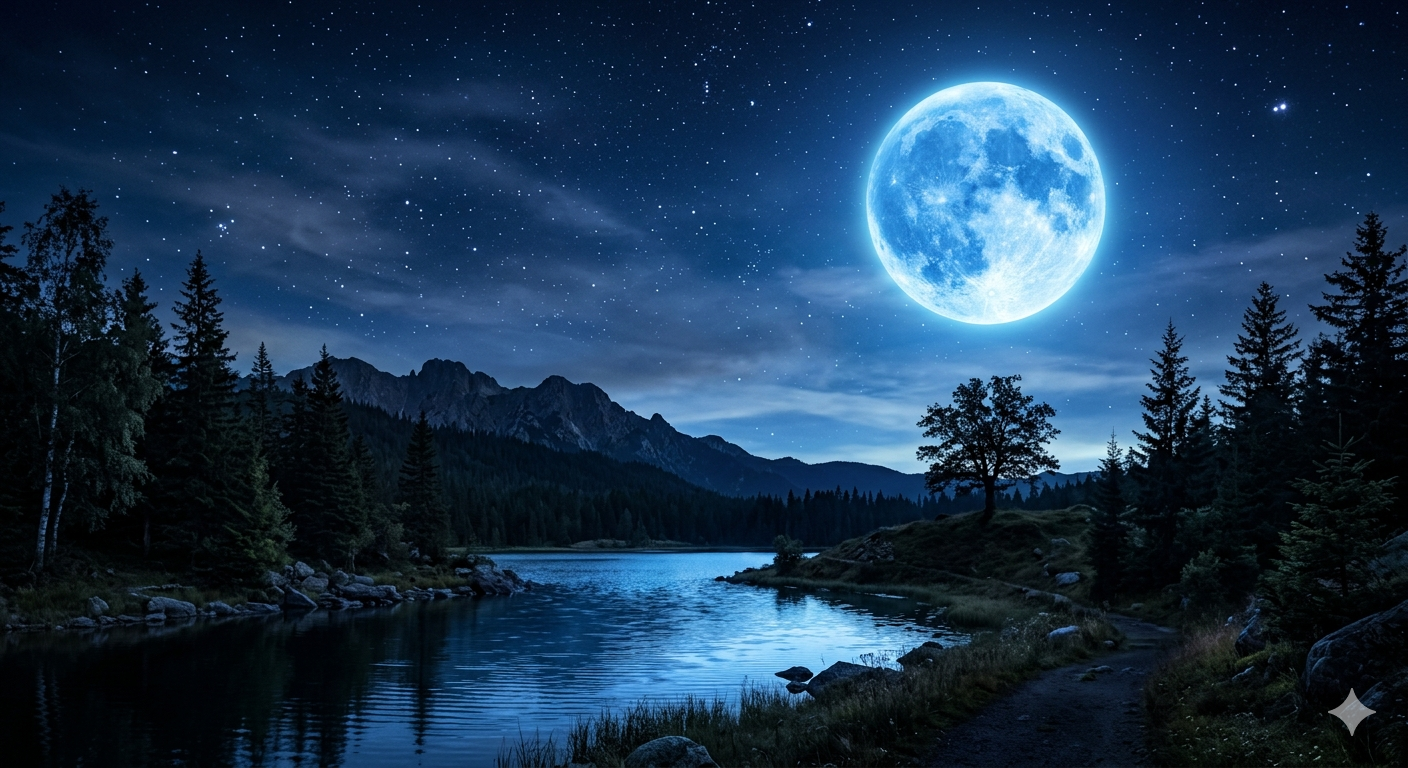
Despite what the name suggests, a Blue Moon does not actually look blue. It appears as a normal full moon—shining in shades of white, yellow, or sometimes a slight orange when it is low on the horizon.
The moon can only take on a literal blue hue under incredibly rare atmospheric conditions. This happens when the atmosphere contains high concentrations of smoke or large dust particles, usually following major forest fires or massive volcanic eruptions.
Idiom Origin: Because this celestial event is so uncommon, it inspired the famous English idiom “Once in a blue moon,” which means something happens very rarely or almost never.
Why Does a Blue Moon Happen?
The phenomenon is driven by the difference between the Earth’s calendar year and the moon’s orbital cycle. A complete lunar cycle (from one full moon to the next) takes about 29.5 days, whereas most calendar months last 30 or 31 days. This small gap accumulates over time.
While a typical year sees 12 full moons, this time gap causes a 13th full moon to squeeze into the calendar every 2 to 3 years. According to the Metonic Cycle, a specific 19-year lunar cycle, a Blue Moon occurs exactly 7 times every 19 years.
How Rare is a Blue Moon?
On average, a Blue Moon happens every 32 months (roughly 2.7 years). It is this exact predictability mixed with long intervals that makes the phenomenon special.
Here is how the idiom “Once in a blue moon” is used in daily American English:
- “I only see him once in a blue moon.” (Meaning: I rarely ever see him.)
- “Once in a blue moon, you run into these kinds of problems.” (Meaning: You hardly ever face these issues.)
Spiritual Significance
In many cultures and spiritual traditions, the Blue Moon holds a unique place. Many believe that its energy is incredibly potent and deeply connected to “Feminine Energy.” People often utilize this extra lunar energy for creativity, manifestation, strengthening intuition, and performing personal rituals.
During a Blue Moon, people into spiritual practices often focus on:
- Spending quality time to heal and strengthen relationships.
- Launching major creative projects or artistic endeavors.
- Practicing deep meditation to heighten intuition and inner awareness.
- Conducting spiritual rituals or intentions for personal growth.
Blue Moon vs. Blood Moon vs. Supermoon
People often confuse a Blue Moon with a Blood Moon or a Supermoon, but they are completely different events.
| Feature | Blue Moon | Blood Moon | Supermoon |
| Definition | The second full moon in a single calendar month. | A red-colored moon caused by a total lunar eclipse. | A full moon that occurs when the moon is closest to Earth. |
| Color | Normal White / Yellow | Red / Copper | Bright White |
| Frequency | Every 2–3 years | Every 1–2 years | Every 6–14 months |
| Cause | Calendar timing mismatch | Earth blocking sunlight, scattering red light | Elliptical orbit alignment (Perigee) |
| Size | Normal size | Normal size | Appears 14% larger and 30% brighter |
A Blood Moon only happens during a total lunar eclipse when Earth completely blocks direct sunlight from reaching the moon. The only light that reflects off the lunar surface is filtered through Earth’s atmosphere, which scatters shorter wavelengths (like blue) and lets longer wavelengths (like red) pass through.
A Supermoon occurs because the moon’s orbit around Earth is oval, not a perfect circle. When the moon hits its closest point to Earth (called perigee) at the exact same time it becomes full, it looks significantly larger and brighter than usual.
The Super Blue Moon
On rare occasions, a Blue Moon and a Supermoon happen at the same time, creating a Super Blue Moon. This is an exceptional celestial treat that occurs roughly once every 10 to 20 years. For instance, a spectacular Super Blue Moon occurred on August 19, 2024. During this event, the moon looked stunningly large and radiant, though it still maintained its natural pearly-white color.
History of the Term
The phrase “Blue Moon” dates back to the 1670s. For centuries, older almanacs relied strictly on the seasonal definition (the third full moon in a season of four). However, in 1946, an author for Sky & Telescope magazine misinterpreted the rule and wrote that a Blue Moon was the second full moon in a single calendar month. This simplified definition caught on globally, became popularized by trivia games, and is now the most widely accepted definition today.
How to View a Blue Moon
You do not need any special equipment like telescopes or binoculars to enjoy a Blue Moon. It looks just like a regular, beautiful full moon. To get the best possible view, keep these simple tips in mind:
- Find an open area with minimal air and light pollution.
- Check the weather forecast ahead of time to ensure clear skies.
- Get away from bright city lights and skyscrapers if possible.
- Look up during peak illumination times (often reported by local astronomy apps) when the moon sits highest and brightest in the night sky.
Conclusion
The Blue Moon is a beautiful reminder of the quiet rhythms of our solar system. While it won’t actually paint the night sky blue, its calendar rarity makes it a special event for people all over the world. It gives us a great excuse to pause, look up at the night sky, and appreciate the wonders of nature. Whether you look at it through a scientific lens, celebrate its spiritual energy, or just appreciate a bright night, a Blue Moon is always a sight worth catching. Keep an eye on the calendar, because the next time one comes around, you won’t want to miss it!