




Oxytocin: Detailed Discussion
1. What is Oxytocin?
Oxytocin is a peptide hormone that plays an important role in childbirth, breastfeeding, social bonding, and certain reproductive functions in both males and females.
It is commonly known as the “birth hormone” because it stimulates uterine contractions during labour. It is also called the “milk-ejection hormone” because it helps release milk from the mammary glands during breastfeeding.
Oxytocin acts by binding to specific oxytocin receptors present in target tissues, such as the uterus, mammary glands, and reproductive organs.
Important distinction: Oxytocin promotes milk ejection, whereas prolactin primarily stimulates milk production.
2. Synthesis and Secretion of Oxytocin
A. Synthesis
- Oxytocin is synthesised by specialised neurosecretory cells in the hypothalamus, mainly in the paraventricular and supraoptic nuclei.
- It is initially produced as a larger precursor protein, which is processed to form the active hormone.
- Oxytocin is transported along the axons of hypothalamic neurons to the posterior pituitary gland, also known as the neurohypophysis.
- During transport, it is associated with a carrier protein called neurophysin I.
B. Secretion
- Oxytocin is stored in nerve endings in the posterior pituitary gland.
- When appropriate nerve impulses arrive, oxytocin is released into the bloodstream.
- Its secretion increases in response to certain physiological stimuli.
The major stimuli include:
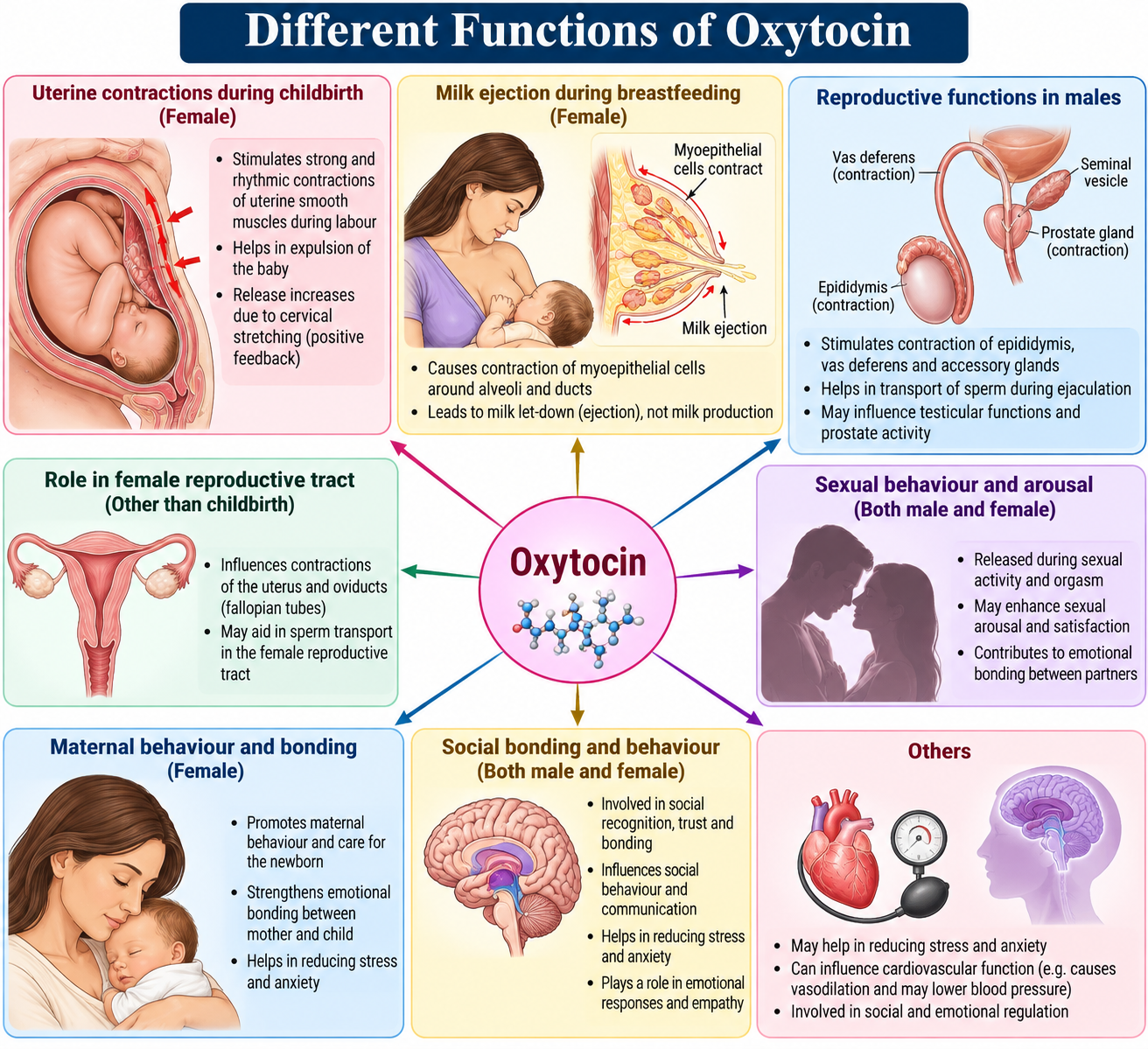
- During childbirth: Stretching of the cervix stimulates oxytocin release, which increases uterine contractions. Stronger contractions can cause further cervical stretching, producing a positive feedback mechanism.
- During breastfeeding: Suckling stimulates oxytocin release, causing contraction of myoepithelial cells around mammary alveoli and ducts, which ejects milk.
- In males and non-pregnant females: Oxytocin may be released in response to sexual activity, touch, and certain social interactions.
3. Chemical Nature of Oxytocin
- Oxytocin is a peptide hormone consisting of nine amino acids, making it a nonapeptide.
- Its molecular formula is C43H66N12O12S2.
- Its molecular mass is approximately 1,007 daltons.
- It contains a disulfide bond that forms a ring-like structure in the molecule.
- It is water-soluble and acts through specific cell-surface receptors.
- Its biological effects are mediated mainly through G-protein-coupled receptors, which activate intracellular signalling pathways.
Because oxytocin is a peptide, it is broken down by digestive enzymes if taken orally as an ordinary tablet. Medical formulations and routes of administration are selected according to the intended use.
4. Role of Oxytocin in Males and Females
A. Role of Oxytocin in Males
Although oxytocin is commonly associated with childbirth and breastfeeding, it also has physiological functions in the male reproductive system.
1. Contraction of the reproductive tract
Oxytocin can stimulate smooth muscle contractions in parts of the male reproductive tract, including the epididymis and vas deferens. These contractions may help move sperm towards the urethra during ejaculation.
Oxytocin may contribute to the emission and expulsion phases of ejaculation by influencing contractions of reproductive ducts and accessory glands.
3. Testicular functions
Oxytocin produced locally in reproductive tissues may influence the contractility of seminiferous tubules and the regulation of steroid metabolism. The precise significance of these effects in human fertility is not fully established.
4. Sexual behaviour and bonding
Oxytocin participates in neural pathways associated with sexual activity, social interaction, emotional processing, and bonding. Its effects vary with the individual and the context.
5. Prostate function
Oxytocin signalling may influence contractions and cellular activity in the prostate. Its potential role in treating prostate disorders remains under investigation.
Important: Oxytocin is not the primary hormone responsible for male sexual development or testosterone production. Testosterone, luteinising hormone (LH), and follicle-stimulating hormone (FSH) have more established roles in these processes.
B. Role of Oxytocin in Females
1. Uterine contractions during childbirth
Oxytocin stimulates the smooth muscles of the uterus, helping produce strong rhythmic contractions during labour. Its release increases through positive feedback as the cervix stretches.
2. Milk ejection during breastfeeding
Suckling stimulates oxytocin release from the posterior pituitary. The hormone causes myoepithelial cells surrounding the mammary alveoli to contract, pushing milk into the ducts and towards the nipple. This is called the milk-ejection reflex or let-down reflex.
3. Reproductive tract contractions
Oxytocin can influence contractions in the uterus and other reproductive tissues. The physiological significance of these effects varies with the stage of the reproductive cycle and pregnancy.
4. Maternal behaviour and bonding
Oxytocin is involved in neural processes associated with maternal behaviour, social bonding, and emotional responses. It contributes to these processes but does not act alone.
5. Sexual response
Oxytocin may be released during sexual arousal and orgasm and can influence contractions of reproductive tissues. However, it is not the sole determinant of sexual desire, arousal, or orgasm.
5. Problems Associated with Oxytocin Deficiency
Oxytocin deficiency is not as well characterised as deficiencies of some other hormones. Low oxytocin levels do not automatically indicate a disease, and there is currently no universally accepted blood test or threshold that reliably diagnoses a clinically significant deficiency in all individuals.
A. Possible problems in males
Potential effects of impaired oxytocin signalling may include:
- Changes in the contractions of the reproductive tract.
- Possible alterations in ejaculation or sperm transport.
- Changes in aspects of social interaction, emotional processing, or stress responses.
However, these are not established diagnostic signs of oxytocin deficiency in men. Erectile dysfunction, low libido, infertility, and premature ejaculation should not automatically be attributed to low oxytocin. These conditions have many possible causes.
B. Possible problems in females
Potential effects may include:
- Difficulty with milk ejection: Impaired oxytocin release or signalling may interfere with the milk let-down reflex, even when milk is being produced.
- Problems with uterine contractions: Oxytocin is essential to normal labour physiology, but weak contractions during labour do not by themselves establish oxytocin deficiency.
- Possible changes in social or emotional functioning: Research has explored links between oxytocin signalling and social behaviour, but these symptoms are nonspecific and cannot diagnose deficiency.
Difficulty breastfeeding is more commonly evaluated by assessing milk supply, infant attachment and suckling, feeding frequency, pain, stress, and other maternal or infant factors.
6. Management of Oxytocin Deficiency in Males and Females
There is currently no established, routine oxytocin-replacement treatment for otherwise healthy men or women diagnosed solely on the basis of suspected low oxytocin. Management depends on the symptoms, the underlying cause, and whether a specific medical condition is present. Research into oxytocin replacement for certain hypothalamic or pituitary disorders is ongoing.
A. Management in Males
1. Medical evaluation
A doctor should investigate symptoms such as ejaculation difficulties, infertility, low libido, or sexual dysfunction rather than assuming that oxytocin is deficient. Depending on the symptoms, evaluation may include reproductive hormones, semen analysis, and assessment of hypothalamic or pituitary function.
2. Treat the underlying condition
Management may involve treating a confirmed hormonal disorder, reproductive tract problem, medication-related effect, or other cause of the symptoms. Testosterone or other hormonal treatments should only be used when clinically indicated; they are not treatments for oxytocin deficiency itself.
3. Oxytocin-based treatment
Oxytocin injections or nasal sprays should not be used independently to improve sexual performance, ejaculation, or fertility. Their effectiveness and safety for these purposes have not been adequately established, and such use is not standard treatment.
B. Management in Females
1. Difficulty with milk ejection
A lactation consultant or healthcare professional can assess breastfeeding technique, infant attachment, feeding frequency, milk production, and maternal factors. Skin-to-skin contact, a comfortable feeding environment, and appropriate breastfeeding support may help the milk-ejection reflex.
2. Weak uterine contractions during labour
In a monitored clinical setting, synthetic oxytocin may be administered by a qualified healthcare professional to induce or strengthen labour when medically indicated. The mother and fetus require appropriate monitoring because excessive uterine contractions can cause serious complications.
3. Suspected hypothalamic or pituitary dysfunction
An endocrinologist may assess the underlying disorder and other pituitary hormones. Oxytocin replacement for suspected deficiency outside established obstetric uses remains investigational; treatment should be guided by specialist assessment and current evidence.
Important precautions
- Do not self-administer oxytocin injections or use unregulated oxytocin nasal sprays.
- Oxytocin is not a proven general treatment for infertility, erectile dysfunction, low libido, anxiety, or depression.
- Oxytocin used to induce or strengthen labour requires medical supervision because it can cause uterine hyperstimulation and other serious adverse effects.
- There is no established dietary supplement that reliably corrects a clinically significant oxytocin deficiency.
Summary
| Heading | Key point |
|---|---|
| What is oxytocin? | A peptide hormone involved in childbirth, milk ejection, and social processes. |
| Synthesis and secretion | Synthesised in the hypothalamus and released into the blood from the posterior pituitary. |
| Chemical nature | A nine-amino-acid peptide hormone. |
| Role in males | Influences reproductive tract contractions, ejaculation, and aspects of social behaviour. |
| Role in females | Stimulates uterine contractions and milk ejection and participates in bonding-related processes. |
| Deficiency problems | Possible effects are incompletely understood; symptoms are nonspecific. |
| Management | Treat the identified underlying condition. Oxytocin medication is used for specific clinical indications, not as routine replacement for suspected deficiency. |
Conclusion: Oxytocin is important in both male and female physiology. However, its roles in childbirth and milk ejection are well established, whereas many proposed effects on sexual function, fertility, and emotional health require further research.
Suspected deficiency should be assessed medically rather than treated on the basis of symptoms alone.